
This week, a customer opened a ticket complaining that there were too many job logs on their system… this meant that when a user searched for their print job with WRKSPLF, they were inundated with a considerable number of job logs, making it difficult to find the relevant spool.
While I find the spool tool relatively convenient, I often see customers using OUTQs as archives. Let’s be clear: OUTQs are not archives! There are different tools that can perform that function. Moreover, for a sysadmin, the spool is an enemy of performance. Replication tools, for example, replicate one spool at a time. Last year, during the migration of an important customer, we found ourselves having to change the migration method due to poor performance in spool restores (and the customer had about 10 million of them).
Let’s get back to the matter at hand… now, the conditions that can cause a job to leave the log are:
- 4 0 *SECLVL, and here we need to investigate whether it is the jobd that passes this parameter when starting the job or whether it is modified later with CHGJOB
- DSPJOBLOG OUTPUT(*PRINT), again, the configuration specified in the job is overridden by printing it with the execution of that command
- SIGNOFF LOG(*LIST), applies only to interactive sessions and ensures that when the interactive session is closed, it leaves the job log
Now, how can I find out the possible cause for the job logs? SQL can be very useful in this case too. In the query example below (you can find the query on my Gist at the following link), I join the OUTPUT_QUEUE_ENTRIES_BASIC view (to extract only jobs with QPJOBLOG files in the QEZJOBLOG print queue) with the JOB_INFO view view (to extract the job execution parameters) and the JOB_DESCRIPTION_INFO view to see the logging parameters in the jobd.
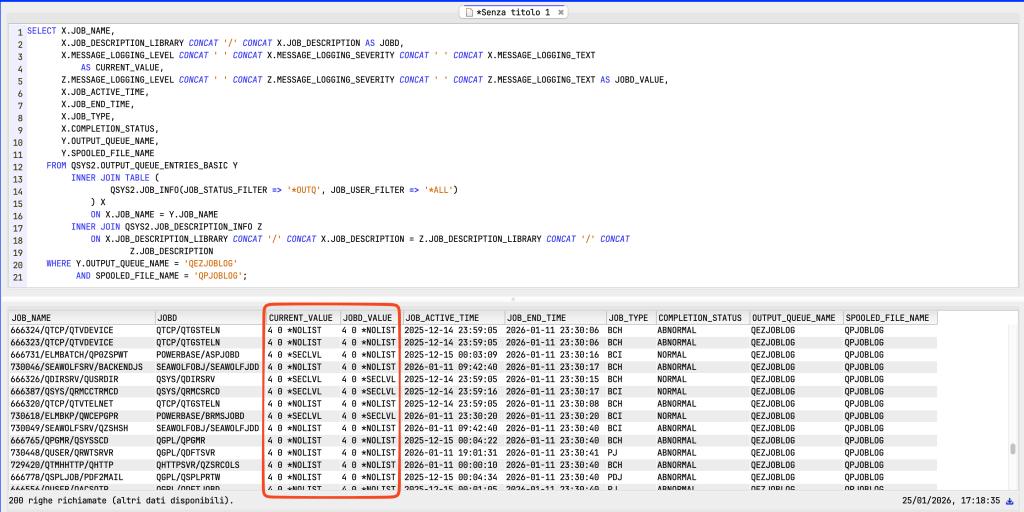
Therefore, if both the jobd and the job have 4 0 *SECLVL as their logging parameter, it means that the job has maintained the settings defined by the jobd. If, on the other hand, the jobd reports a different value but the job maintains 4 0 *SECLVL, then it may mean that the job was submitted with a different parameter or that the job execution parameters were changed with the CHGJOB command. If the job value is also different from 4 0 *SECLVL and the job is a batch job, a DSPJOBLOG OUTPUT(*PRINT) has been performed. If it is interactive, the same reasoning is likely to apply, although it is possible to specify SIGNOFF LOG(*LIST).
What if I want to analyse active jobs? Well, in this case, the query changes slightly, as there will most likely be no spool…
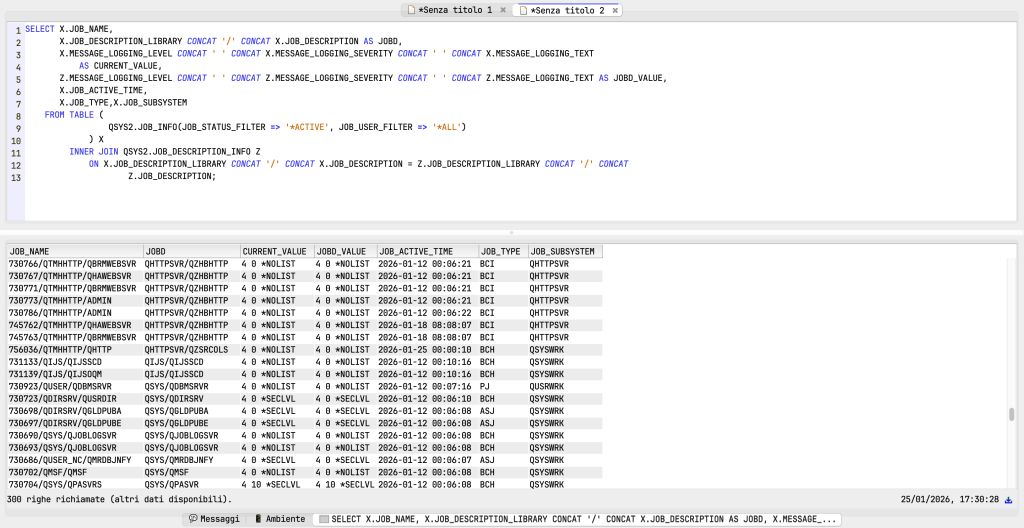
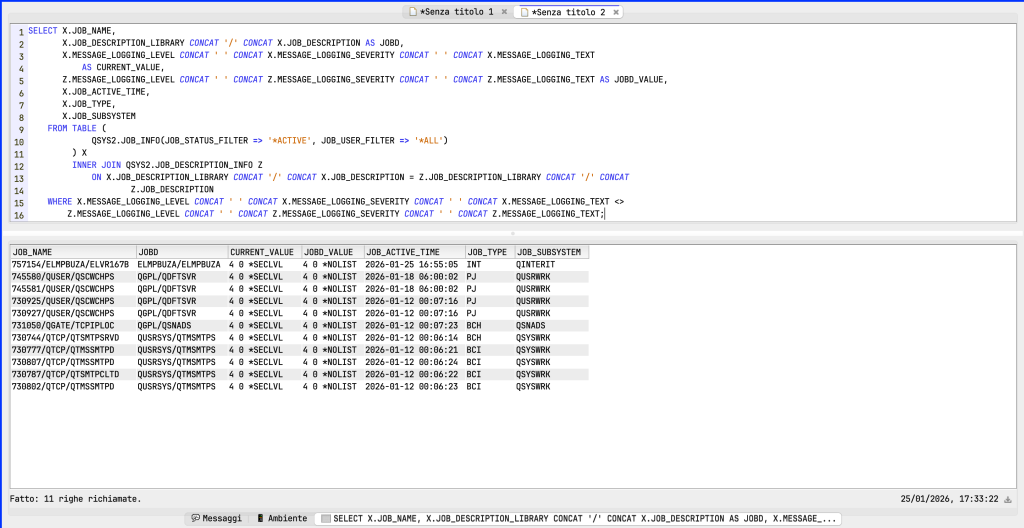
Or, if I want to check only job with defference between current settings and JOBD:
And you, have you ever considered using SQL for this type of analysis? I remind you that all the code is available on my GIST, which you can access at this link: https://gist.github.com/buzzia2001
Andrea